


Reading Financial Statements
How the three financial statements of a company are built from double-entry bookkeeping, how one links to the next, and how to read them from the published accounts of real companies: Walmart's income statement and cash flow statement line by line, the return on equity of Costco and Microsoft taken apart into margin, turnover, and leverage, and the working capital cycle of a supermarket chain and a machine maker. The unit shows month by month why a profitable company can run out of cash, and which signs in a set of accounts have predicted a later misstatement.
On 25 June 2002 WorldCom, a large American long-distance telephone company, announced that about 3.8 billion US dollars of its costs over the previous five quarters had been recorded as assets instead of expenses, and that the profits it had reported for those quarters did not exist. Four weeks later the company was in bankruptcy. Everything that had happened was recorded, in principle, in three documents that the company published every quarter and that every listed company in the world publishes in some form: the balance sheet, the income statement, and the cash flow statement. Unit 1 quoted revenue and profit from these documents, and every later unit will quote from them again. This unit teaches how they are built, how they fit together, how to read them with a calculator, and where to look when something in them is wrong.
1 The three statements
Once a year a company publishes an annual report, and the heart of it is a set of financial statements, the tables in which the company accounts for what it owns, what it owes, what it earned, and what happened to its cash. There are three of them, and the easiest way to keep them apart is by the kind of time each one covers.
- The balance sheet is a photograph. It lists, at one moment, usually the last day of the financial year, everything the company owns or controls, which the accountants call its assets, and every claim on those assets, which are the liabilities owed to outsiders and the equity that belongs to the owners.
- The income statement is a film. It runs over the financial year and records the revenue the company earned, the costs it incurred to earn it, and the difference between the two, which is the profit or the loss of the year.
- The cash flow statement is the bank account. It records, over the same year, the cash that actually came in and went out, sorted into the cash from running the business, the cash spent on and received from investments, and the cash raised from or returned to lenders and owners.
The three are one system, and the links between them are the first thing to learn, because a reader who knows the links can check one statement against another and notice when the story they tell does not add up.
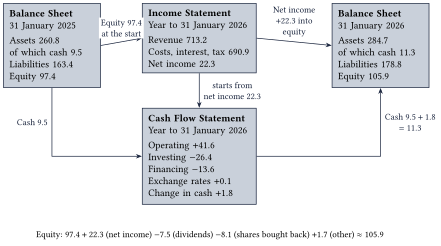
Figure 1 draws the system for one real company. Walmart is the US retailer based in Bentonville, Arkansas, and the largest company in the world by revenue, with total revenues of 713.2 billion US dollars in the financial year that ended on 31 January 2026, according to the annual report it filed on 13 March 2026. The two balance sheets at the ends of that year, the income statement between them, and the cash flow statement underneath are the four documents this unit reads.
Where the statements are found depends on the country. In the United States every listed company files an annual report with the Securities and Exchange Commission, the agency that supervises listed companies, and the report is called a Form 10-K; the SEC publishes every filing on its database EDGAR, free of charge. In the United Kingdom every company, listed or not, files its accounts with Companies House, the registrar of companies, where they can be read for free. Listed companies in the European Union and most of the world report under IFRS, the International Financial Reporting Standards, and American companies under US GAAP, the generally accepted accounting principles of the United States; the two rule books differ in details, not in the three statements. British English has its own names for some of the lines: the income statement is the “profit and loss account”, revenue is “turnover”, receivables, the money that customers still owe, are “debtors”, and payables, the money still owed to suppliers, are “creditors”. This program uses the international words, and it calls the year the statements cover the financial year, which the rule books call the “accounting period”.