Business Management Masterclass12-Week Program in Business Management

Study how companies compete for customers and decide where to put their money, one unit per week, with real cases and the published research of management scholars working today.

  • Certificate
  • Online
  • Join a community of 4000+

Exhibit 1

A moving line cut the time to assemble one Model T chassis by almost nine tenths

Unit 4 explains why it worked, and what Toyota changed later.

Workers along the moving assembly line at Ford's Highland Park plant in 1913, each fitting parts as the work passes in front of them.
Source: Ford Motor Company, Highland Park, Michigan, 1913 to 1914; times are approximate. Photograph: Unknown author, Public domain, Wikimedia Commons.

Our alumni study at

  • Massachusetts Institute of Technology
  • Harvard University
  • Stanford University
  • California Institute of Technology
  • Princeton University
  • University of Oxford
  • ETH Zurich
  • Imperial College London
  • University of California, Berkeley
  • University of Chicago
  • Yale University
  • Columbia University
  • Technical University of Munich
  • University of Toronto
  • University of Tokyo
  • EPFL

About the program

The Business Management Masterclass takes you through the work of running a company one unit at a time. You enrol, and from then on a new unit reaches you every week. Each unit is a chapter written for this program, with real company cases, worked calculations, and the published research of managers and management researchers who are active today.

A quiz completes every unit and opens the next. At the end you sit a final exam and receive a certificate with a public verification page.

  • Structured. A fixed sequence of units that starts with the numbers every manager uses and ends with the questions business schools are researching now.
  • Demanding and fair. Each framework is explained, applied to a real company, and checked with numbers you can work out yourself.
  • Recognized. A certificate and a transcript, both with a verification ID that anyone can check online.

How the program works

Exhibit 2

Double-entry bookkeeping has been printed since 1494

Painting of Luca Pacioli in a grey habit at a green table, drawing a geometric figure on a slate beside an open book, with a young man standing behind him and a glass polyhedron hanging in the air.
Source: Luca Pacioli, Summa de arithmetica, Venice, 1494, the first printed description of the rule that every entry is recorded twice. Unit 5 starts there. Painting: Jacopo de' Barbari, Public domain, Wikimedia Commons.

Who is this program for?

For high school students, university students, and lifelong learners. You need no prior knowledge of business: Unit 1 gives every participant the same arithmetic and the case method.

High School Students

You want to study business or start something of your own. The masterclass gives you a head start for university and the theory behind business case competitions.

  • School mathematics is enough
  • Certificate for applications
  • Theory for case competitions

University Students

You study business, economics, engineering, or law. The masterclass shows how strategy, operations, and finance fit together in one firm, before an internship or a case interview.

  • Real company cases
  • Current research papers
  • A weekly tool of the field

Lifelong Learners

You lead a team, run a shop, or plan a start-up. The masterclass gives you the frameworks and the numbers behind decisions you already make.

  • No deadlines, pause any time
  • Unit 1 refreshes the business arithmetic
  • Read on screen or as PDF

How does it work?

In the Advanced masterclass a new unit arrives every week, and the certificate follows the final exam after week 12

  1. 1

    Enrol

    Week 0

    Create your account with your email address, choose your masterclass, and pay the Tuition Fee. Your program starts at once.

  2. 2

    Receive your unit

    Week 0, then every Monday

    Unit 1 arrives immediately and every further unit on a Monday, as a web page and as a PDF to keep.

  3. 3

    Study

    Every week

    Work through the cases, the frameworks, and the worked calculations, and answer the questions in the text as you go. A day later we send further reading, including research papers that are free to read.

  4. 4

    Take a quiz for every unit

    Before the next unit

    Each unit has its own quiz: ten questions, open book, no time limit. You submit it before the next unit is sent to you.

  5. 5

    Sit the final exam

    After the last unit

    50 questions across the units of your masterclass in 60 minutes, open book. You pass with 70% and have up to 3 attempts.

  6. 6

    Earn your certificate

    When you pass

    Certificate and transcript as PDF, each with a verification ID and a personal link you can share.

Schedule of the Advanced masterclass. Foundation ends after week 8, Advanced + Innovation and Entrepreneurship after week 16. Once you have submitted a quiz you can ask for the next unit early, at the earliest 24 hours after the previous one.

Topics

Sixteen units in three groups, each group led by one of the questions it answers.

Workers on the moving assembly line at Ford's Highland Park plant, Michigan, in 1913.
Photograph: Unknown author, Public domain, Wikimedia Commons.

Units 1 to 8, How a Firm Works

Why did Kodak lose its market?

What managers do and the numbers they use, how firms compete and win customers, how they make things well, how to read their accounts and judge an investment, what motivates people at work, and why some companies last for a century while others vanish in ten years.

Answered in Unit 8

Gantry cranes and stacked containers at the Burchardkai terminal in Hamburg.
Photograph: Raimond Spekking, CC BY-SA 4.0, Wikimedia Commons.

Units 9 to 12, Structure, Capital, and the World

What is a company worth?

How to draw the boundaries and the reporting lines of a firm, how leaders decide under uncertainty, what a company is worth and what its capital costs, and how goods cross the world in containers.

Answered in Unit 11

The garage in Palo Alto where Hewlett-Packard began in 1938.
Photograph: BrokenSphere, CC BY-SA 3.0, Wikimedia Commons.

Units 13 to 16, Innovation and Entrepreneurship

How do founders test an idea?

Why strong incumbents lose to newcomers, how founders run experiments before they spend, how venture investors pick and price start-ups, and why platforms and artificial intelligence reward the largest players.

Answered in Unit 14

Exhibit 3

Sixteen units in three masterclasses

The 16 units and the masterclasses that contain them. Select a unit title to read its summary.
Unit Title Foundation Advanced Advanced + Innovation and Entrepreneurship
Units 1 to 8, How a Firm Works
1
2
3
4
5
6
7
8
Units 9 to 12, Structure, Capital, and the World
9 Not included
10 Not included
11 Not included
12 Not included
Units 13 to 16, Innovation and Entrepreneurship
13 Not included Not included
14 Not included Not included
15 Not included Not included
16 Not included Not included
Source: BusMgmt Masterclass curriculum. One unit per week; select a title to read its summary. The full curriculum.

Research presented in the program

Every unit contains a research spotlight: the published work of a management researcher, explained at your level and linked to the original paper.

The scientists named here are not contributors to the BusMgmt Masterclass, are not affiliated with it, and have not endorsed it. The program presents and explains their published research, with references to the original papers. Portraits: (CC BY-SA 4.0); (CC BY 2.0); (CC BY 2.0); (CC BY 3.0); (CC BY 2.0); (CC BY-SA 2.0); (CC BY-SA 2.0); (CC BY-SA 2.0), all via Wikimedia Commons, cropped.

All research spotlights

Tuition Fee

Choose the masterclass that fits you. One Tuition Fee, paid once, covers every unit, quiz, the final exam, and your certificate.

Exhibit 4

Advanced covers twelve units for a single Tuition Fee of $55

8 weeks

Foundation

The fundamentals of management: strategy, customers, operations, the accounts, and people at work.

Tuition Fee$35$39
Enrol in Foundation
  • 8 weekly units as web page and PDF
  • Quiz and further reading for every unit
  • Final exam, certificate, and transcript
Topics in this program
  1. 01
    The Manager's Toolkit
  2. 02
    Industries, Competitors, and Competitive Advantage
  3. 03
    Customers, Markets, and Marketing
  4. 04
    Operations, Quality, and Lean Production
  5. 05
    Reading Financial Statements
  6. 06
    Money over Time and Investment Decisions
  7. 07
    People, Motivation, and Teams
  8. 08
    The Rise and Fall of Companies
  9. 09
    Organizational Design and the Boundaries of the Firm
  10. 10
    Leadership, Decisions, and Corporate Culture
  11. 11
    Corporate Finance and Valuation
  12. 12
    Global Supply Chains and International Business
  13. 13
    InnovationDisruptive and Architectural Innovation
  14. 14
    InnovationStart-ups and Business Experiments
  15. 15
    InnovationVenture Capital and Start-up Finance
  16. 16
    InnovationPlatforms, Network Effects, and Artificial Intelligence
16 weeks

Advanced + Innovation and Entrepreneurship

The full program plus four units on innovation, start-ups, venture capital, and platforms.

Tuition Fee$85$119
Enrol in Advanced + Innovation and Entrepreneurship
  • 16 weekly units as web page and PDF
  • Quiz and further reading for every unit
  • Final exam, certificate, and transcript
Topics in this program
  1. 01
    The Manager's Toolkit
  2. 02
    Industries, Competitors, and Competitive Advantage
  3. 03
    Customers, Markets, and Marketing
  4. 04
    Operations, Quality, and Lean Production
  5. 05
    Reading Financial Statements
  6. 06
    Money over Time and Investment Decisions
  7. 07
    People, Motivation, and Teams
  8. 08
    The Rise and Fall of Companies
  9. 09
    Organizational Design and the Boundaries of the Firm
  10. 10
    Leadership, Decisions, and Corporate Culture
  11. 11
    Corporate Finance and Valuation
  12. 12
    Global Supply Chains and International Business
  13. 13
    InnovationDisruptive and Architectural Innovation
  14. 14
    InnovationStart-ups and Business Experiments
  15. 15
    InnovationVenture Capital and Start-up Finance
  16. 16
    InnovationPlatforms, Network Effects, and Artificial Intelligence
Tuition fees are one-time payments and include applicable taxes. Secure payment by card through Stripe.
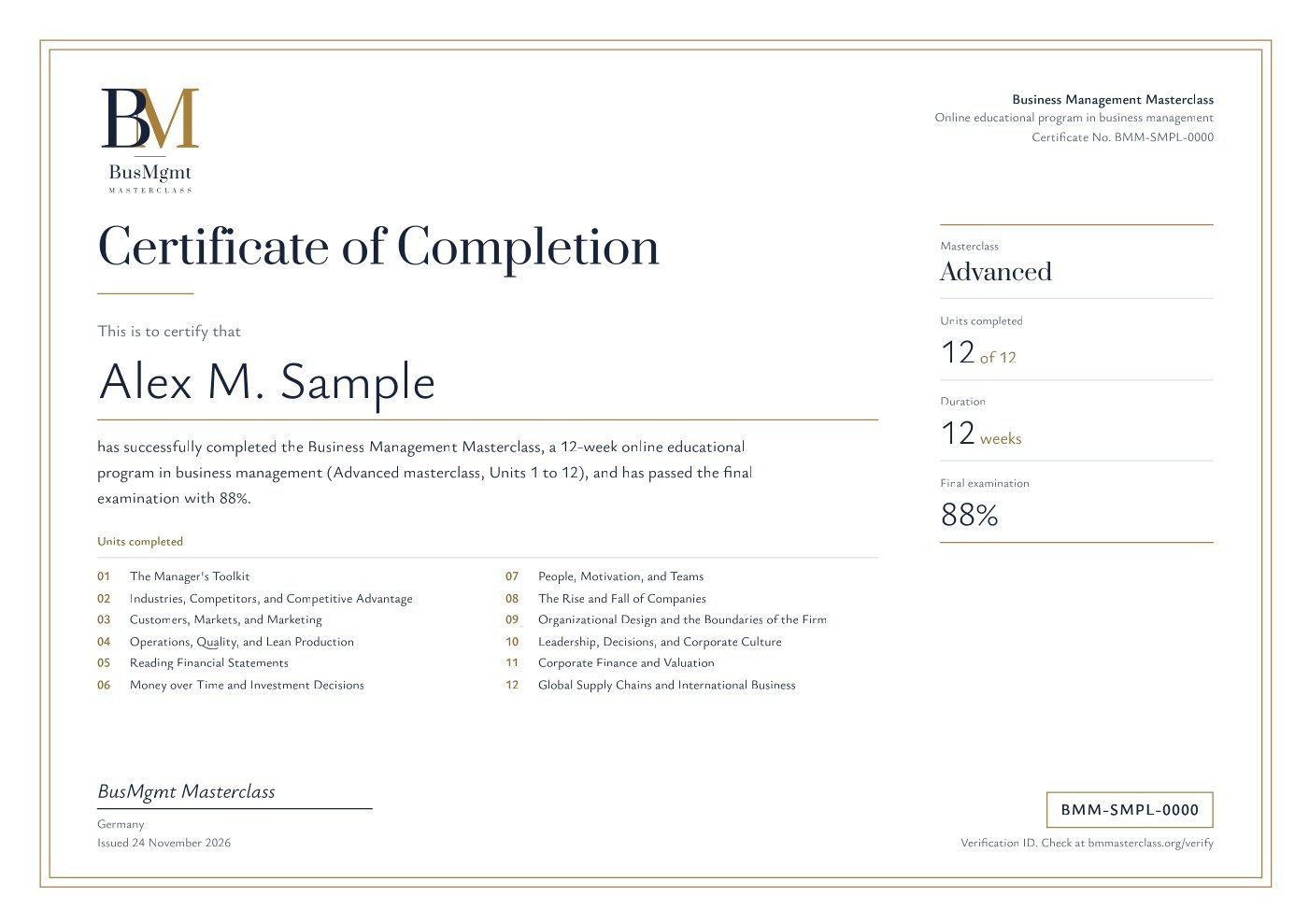
Sample certificate of completion of the Business Management Masterclass, with the verification ID

Your certificate

Participants who pass the final exam receive a certificate of completion. It states your name, the masterclass, its duration, and the units you completed.

  • Certificate and transcript. The transcript lists your score in every unit quiz and in the final exam.
  • Verifiable. Both documents carry a verification ID that can be checked on this website.
  • Shareable. Your personal verification link shows your result to universities and employers.
First page of Unit 3: Customers, Markets, and Marketing

In 2023 the residents of Germany made about 251 million trips with at least one night away from home, which is roughly three trips for every resident. No hotel chain, airline, or tour operator sells to all of these travellers. Each of them chooses a part of this crowd, learns what that part wants, sets a price it will pay, and then tries to keep it coming back. The same choices face a bakery, a software company, and a maker of aspirin. This unit is about the customer: who the customer is, what the customer pays, what a customer is worth to a company over the years, and how a company finds all of this out without fooling itself.

Unit 3, page 1

Sample unit

Read one complete unit before you enrol, exactly as participants receive it: the cases, the frameworks, the worked calculations, and the research spotlight.

Unit 3: Customers, Markets, and Marketing

15 pages, web page and PDF

The unit opens with six questions:

  1. How does a company divide a market of millions of people into a handful of segments, and how does it choose which one to serve?
  2. Why can a 10 per cent price cut lower a company's revenue, and when does it raise it?
  3. What is a customer worth over the years, and how much may a company spend to win one?
  4. Why does a subscription business with a 90 per cent yearly retention rate look very different from one with 80 per cent, although the numbers seem close?
  5. What is a brand, in money, and where does the money a shopper pays go on its way back to the maker?
  6. Why does a well-designed survey still mislead, and what does a company do instead?

Academic community

Masterclass participants come from all over the world, and when you complete the program you stay part of a network of people who care about how organizations are run.

The academic community in figures
4000+Managers and students of management in our community
90+Countries represented
750+Schools and universities represented

Biz-Connect

Our alumni program introduces former participants to each other across countries, for advice on studies and applications, for practice partners before case interviews, and for shared projects.

Opportunities

Past participants hear from us about scholarships, business competitions, summer schools, and other academic opportunities in management and entrepreneurship.

Close to research

The program shows you where management research happens and how it is done, so that your next step at school, at university, or at work is an informed one.

The academic community

Background: Terminal 9 of the Kwai Tsing container terminals in Hong Kong at night. Photograph: Mk2010, CC BY-SA 3.0, Wikimedia Commons.

Frequently asked questions

Who is this program for?

For high school students, university students, and lifelong learners. High school students use it to get ahead in business before university and to prepare for competitions such as the Diamond Challenge or the business case of the International Economics Olympiad. University students in business, economics, engineering, or law take it as a supplement to their degree or before an internship and case interviews. Lifelong learners, among them many people who lead a team, run a shop, or think about a start-up, use it to learn the frameworks and the numbers behind decisions they already make. The Foundation masterclass suits a first contact with the subject; the Advanced masterclass goes on to organizational design, leadership, valuation, and global supply chains.

What do I need to know before I start?

School mathematics is enough: percentages, simple equations, and reading a table or a graph. You do not need any prior knowledge of business, accounting, or economics. Unit 1 teaches every tool the later units use, among them margins, growth rates, the break-even quantity, and how to work through a case. Discounting is taught in Unit 6 before any unit uses it, and every formula is explained step by step.

How much time do I need each week, and are there live sessions?

Most participants spend three to five hours on a unit, including the quiz. The units on financial statements and on valuation take longer if you rebuild the worked cases with your own figures, which we recommend. The program is fully online and has no live sessions, so it works in every time zone and next to school or work. You receive the units by email and read them on the website or as PDF; quizzes and the final exam are taken on the website.

Can I finish the program in less than 12 weeks?

Yes. A new unit is scheduled for every Monday, but once you have submitted the quiz of a unit you can ask for the next one ahead of schedule, from your dashboard or from the email we send you. The earliest moment is 24 hours after the previous unit was sent. We recommend the weekly rhythm, because the material needs time to settle, but the pace is your decision.

What happens if I fall behind or have to pause?

Nothing is lost. The next unit is only sent once you have submitted the quiz of the current one, so the program waits for you. You can pause for a week or for a term and continue at any time. There is no penalty and no deadline.

How does the final exam work?

After the last unit you sit the final exam online: 50 multiple-choice questions across the units of your masterclass, drawn individually for each participant, with a time limit of 60 minutes. It is open book. You pass with 70% correct answers. If you do not pass, you can try again after 3 days with new questions, up to 3 attempts in total.

All questions

Begin your 12 weeks in business management

Start the Masterclass
Masterclass
Advanced
Units
1 to 12
Duration
12 weeks
Final exam
50 questions, 60 minutes
Tuition Fee
Formerly $69 $55