 Image: Kolforn (Kolforn) (CC BY-SA 4.0)
How many coffees pay the rent
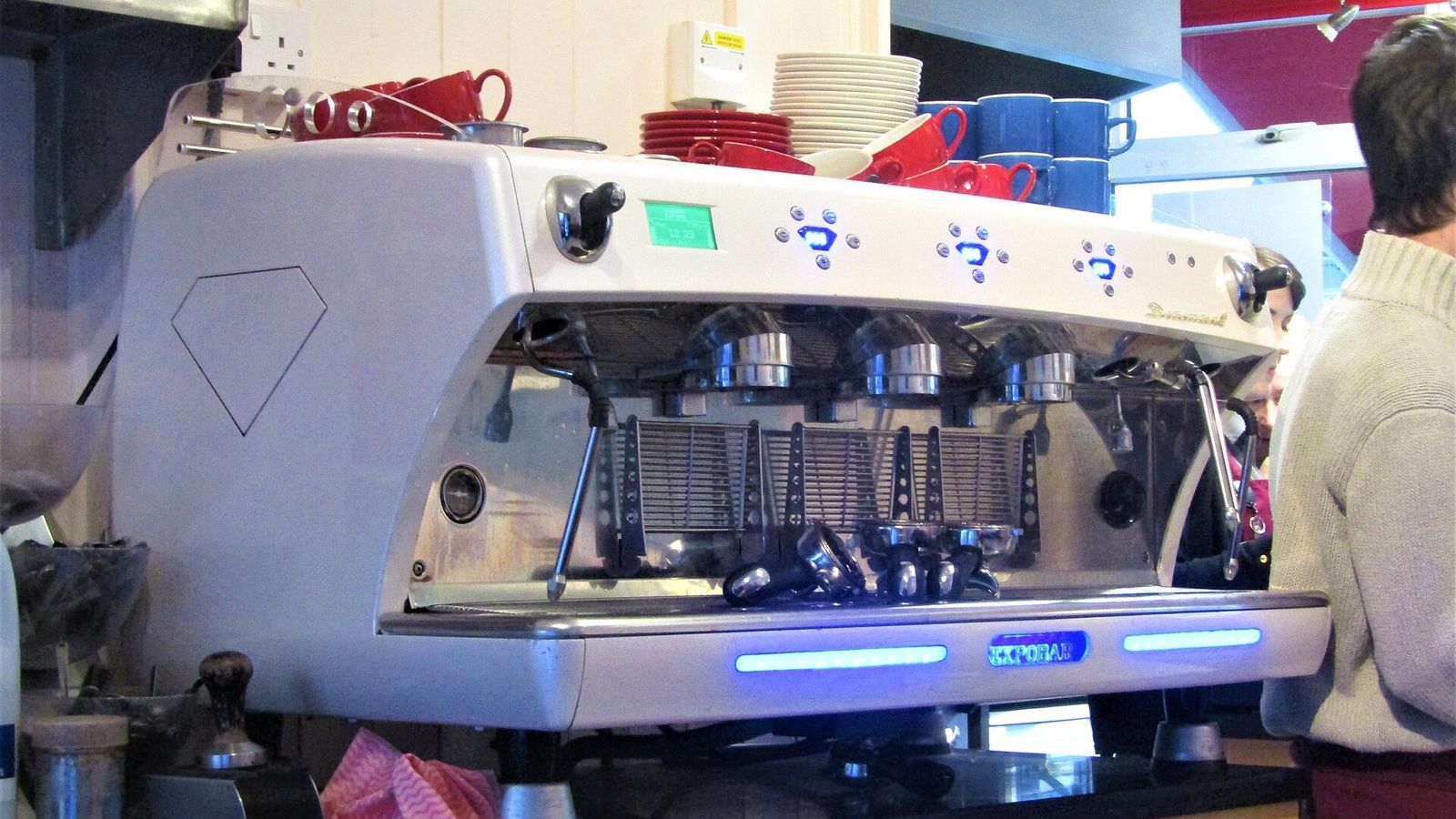
A cappuccino costs 3.20 euros in a cafe in a mid-sized European town. The milk, the beans, the cup, and the lid cost the owner about 55 cents. The other 2.65 euros does not go into anyone's pocket. It goes first towards the rent, the wages, the electricity, and the card terminal fees, and only after all of those are covered does the next cup earn a profit. The question every cafe owner answers, usually by instinct and often wrongly, is how many cups that takes.
The figures in this article are stated assumptions, chosen to be typical of a small independent cafe in 2026 rather than taken from one real business, and you should replace them with your own. The method is what matters, and it is the one Unit 1 of the masterclass uses for every firm from a cafe to a car plant.
Two kinds of cost
Start by sorting the costs into two piles. Fixed costs are the ones that arrive whether the cafe sells one cup or a thousand. Suppose the rent is 2,400 euros a month, two employees on part-time contracts cost 4,800 euros a month including social contributions, electricity, water, insurance, and the card terminal come to 600, and the loan on the espresso machine and the fit-out costs 400 a month. That is 8,200 euros a month of fixed cost, call it \(FC\).
Variable costs are the ones that come with each cup. Beans at a reasonable wholesale price cost about 20 cents for the 18 grams in a double shot, the milk about 20 cents, the cup and lid about 15 cents if the drink goes out of the door, and we will say 55 cents in all, the variable cost per item, \(v\). The owner's own time is left out, which is the usual mistake of small businesses; we come back to it.
The contribution and the break-even
Each cup sold at a price \(P\) of 3.20 euros contributes \(P - v\), which is 2.65 euros, towards the fixed costs. The break-even quantity is the number of cups at which the contributions add up to the fixed costs:
\[ Q^{*} = \frac{FC}{P - v} = \frac{8{,}200}{2.65} \approx 3{,}094 \text{ cups a month.} \]If the cafe opens 26 days a month, that is 119 cups a day, or about 15 an hour over an eight-hour day. Below that, every month ends in a loss. Above it, each extra cup adds 2.65 euros to profit. A cafe selling 150 cups a day makes 150 times 26 times 2.65, which is 10,335 euros of contribution, minus 8,200 of fixed cost, so 2,135 euros a month of profit before the owner pays herself.
The same result can be stated as revenue. The contribution margin as a share of price is \(m = (P - v)/P\), which is 2.65/3.20, or 82.8 per cent. The break-even revenue is \(FC/m\), which is 8,200 divided by 0.828, or about 9,900 euros a month. A cafe owner who knows her monthly takings can compare them with that figure without counting cups.
What a 10 per cent price cut does
Now suppose a rival opens across the street and the owner cuts the cappuccino to 2.88 euros, a reduction of 10 per cent. The variable cost is unchanged at 55 cents, so the contribution per cup falls from 2.65 to 2.33 euros, a drop of 12 per cent. The break-even rises to 8,200 divided by 2.33, which is 3,519 cups a month, or 135 a day. A 10 per cent price cut has raised the number of cups she must sell to stand still by 14 per cent.
That asymmetry is the central fact of pricing in a business with high fixed costs and a high contribution margin. Because so little of the price is variable cost, almost all of a price cut comes straight out of the contribution, and the volume needed to make it up is larger than the cut. For the price cut to be worth making, it would have to bring in at least 14 per cent more customers, and it would have to do so without the rival cutting again.
Go the other way and the same arithmetic helps. A rise to 3.50 euros, about 9 per cent, lifts the contribution to 2.95 and lowers the break-even to 2,780 cups, or 107 a day. The cafe can lose up to 10 per cent of its customers and be no worse off. Whether it will lose more than that is the question of price elasticity that Unit 3 takes up, and the honest answer is that nobody knows until they try.
The owner's wage and the real break-even
Many small businesses report a profit and are still a bad deal for the person running them, because the owner's hours are not in the costs. If the owner works 50 hours a week and would earn 2,800 euros a month doing something else, that sum belongs in the fixed costs as the opportunity cost of her time. The fixed costs become 11,000 euros a month, and the break-even at the original price rises to 4,151 cups, which is 160 a day. The cafe that looked comfortable at 150 cups a day is now 10 cups short of paying its owner a market wage.
The food and the second coffee change the picture again. A cafe does not sell only cappuccinos. If a quarter of the customers also buy a pastry with a price of 2.80 and a variable cost of 1.10, the average contribution per customer rises from 2.65 to 2.65 plus 0.25 times 1.70, which is 3.08 euros. At that figure the break-even, including the owner's wage, falls back to 3,571 customers a month, or 137 a day. The pastry case earns its space.
Three things the number cannot tell you
The break-even assumes that the variable cost per cup is the same for the first cup and the three thousandth, that the fixed costs stay fixed whatever the volume, and that all cups are sold at the same price. None of these is quite true. The milk gets cheaper per litre when the order grows, a third employee becomes necessary at some volume and the fixed costs jump, and a loyalty card gives every tenth coffee away. The number is a first approximation, and its job is to tell the owner the order of magnitude of what she needs and the direction in which each decision moves it.
The second thing the number cannot tell you is whether the customers exist. A break-even of 119 cups a day is reachable on a street with 2,000 passers-by an hour and hopeless on one with 200. Counting the people who walk past, at the hours the cafe would be open, is the cheapest piece of market research there is, and it should be done before the lease is signed.
The third is the timing. The fixed costs are paid every month; the customers arrive unevenly, and the quiet weeks of January have the same rent as the busy ones of June. A cafe that breaks even on average can still run out of cash in the winter, which is the subject of a later article on the difference between profit and cash and of Unit 5.
Unit 1 of the masterclass works the break-even of a cafe as its first worked case and then turns the same tool on the Model T and on a software company, where the variable cost per copy is close to zero and the break-even depends almost entirely on the fixed cost of writing the program. The interactive element of the unit lets you move the price, the rent, and the cost per cup and watch the break-even line shift.