 Image: University of Chicago Law School
Why firms exist
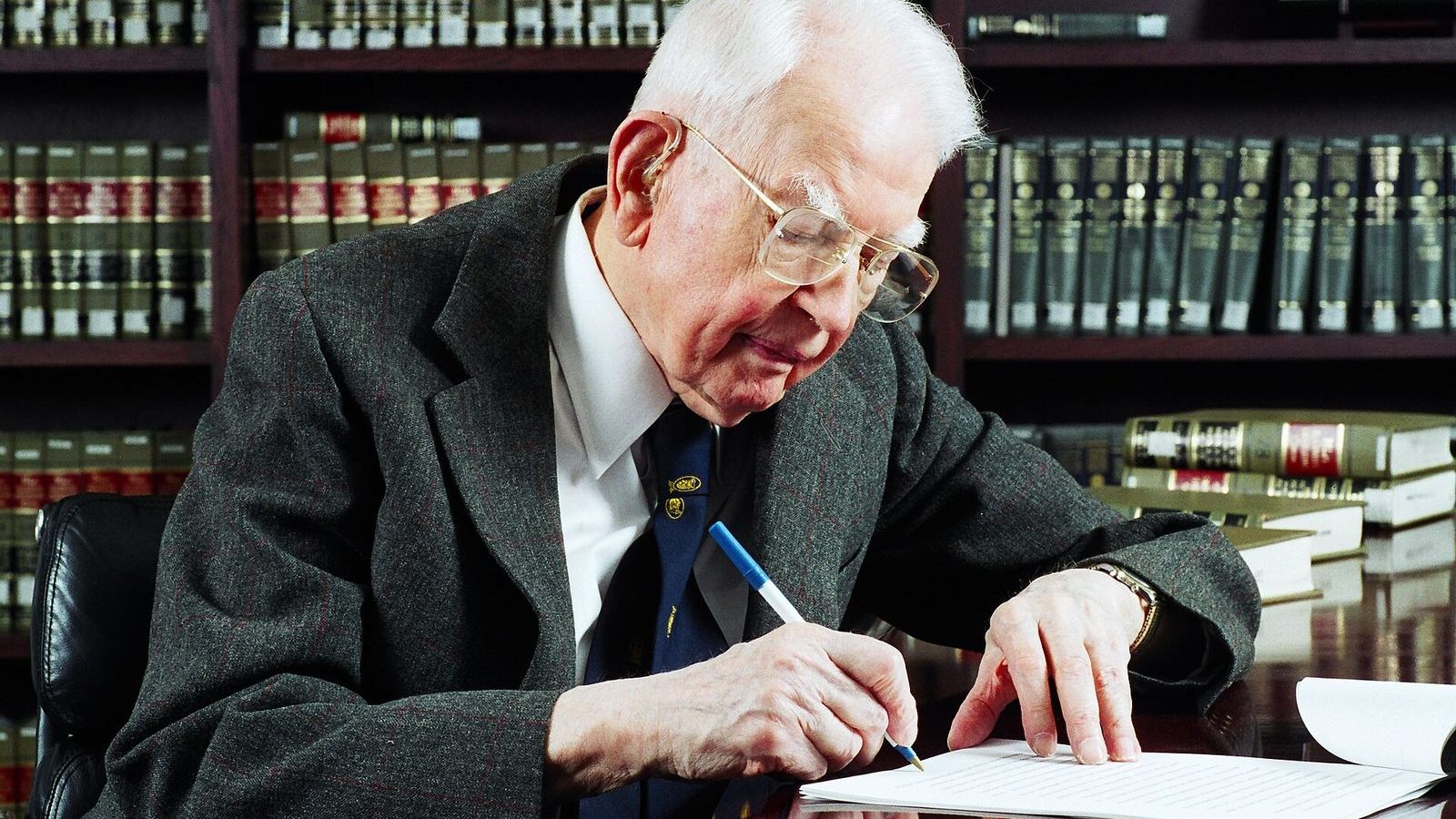
In 1931 and 1932 a twenty-year-old student from the London School of Economics spent a year travelling around the United States on a scholarship, visiting factories and asking managers why they did what they did. Ronald Coase had been taught that prices coordinate the economy: the price system tells a farmer what to grow and a shoemaker what to make, without anyone giving orders. What he saw in the factories was orders. Inside a firm, a manager told a worker to move from one bench to another, and no price changed hands. If the price system worked so well, why was so much of the economy organized by command instead?
The paper that came out of the trip, 'The Nature of the Firm', was published in the journal Economica in 1937 and ignored for thirty years. It is now among the most cited papers in economics, and the 1991 Nobel prize in economic sciences was awarded to Coase largely for it. The question it asks is the one Unit 9 of the masterclass is built around.
Coase's answer
Using the market costs something. To buy a part from a supplier, a firm must find the supplier, agree a price, write a contract that covers what happens if the part is late or faulty, and enforce it. Coase called these the costs of using the price mechanism; the term now used is transaction costs. When they are high enough, it is cheaper to make the part inside the firm, where a manager can simply tell someone what to do and adjust the instructions as circumstances change. A firm exists because, for some transactions, command is cheaper than contract.
The same argument sets the firm's limits. Managing has its own costs, and they rise as the firm grows: the manager's attention is spread thinner, mistakes multiply, and the people inside the firm have less reason to be efficient than a supplier who can be replaced. The firm grows until the cost of organizing one more transaction inside it equals the cost of buying that transaction in the market. That is the boundary of the firm, and Coase's Nobel lecture restates the idea in a few pages that are still the best introduction to it.
Williamson and the hold-up
Coase's answer left a question: which transactions have high costs? Oliver Williamson, in work from the 1970s onwards that earned him the 2009 Nobel prize, gave the answer that managers still use. The cost of using the market is high when the transaction requires an investment that is specific to the other party, when it recurs, and when the future is uncertain enough that no contract can cover it.
The central case is the hold-up. A supplier is asked to build a plant next to a car maker's factory to deliver seats on an hourly schedule. The plant is worth a great deal to that customer and little to anyone else. Once it is built, the car maker can demand a lower price, knowing that the supplier has nowhere else to sell, and the supplier, foreseeing this, either refuses to build or demands a contract so detailed that it cannot be written. Where the investment is specific and the contract cannot cover the future, Williamson argued, the transaction will be brought inside a firm, because inside a firm the dispute is settled by a manager rather than by a threat.
Unit 9 turns this into the make-or-buy rule in words: make when the transaction is specific, frequent, and uncertain; buy when the market is thick, meaning many suppliers and many buyers for a standard item. A car maker buys its tyres and makes its engines, and the rule explains why. It also explains the cases in each direction that the unit works through, such as General Motors spinning off its parts business as Delphi in 1999 once the parts had become standard enough to buy.
Hart and the question of ownership
Williamson's firms settle disputes by authority, but he did not say where authority comes from. Oliver Hart, with Sanford Grossman in a 1986 paper and with John Moore in 1990, supplied the answer: ownership. When a contract cannot specify what should happen in every future situation, and no real contract can, someone has to decide in the situations the contract left out. That right, which Hart called the residual right of control, belongs to whoever owns the asset. The owner of the seat plant decides what the plant does when the contract is silent, and that is what being the owner means.
This turns the boundary of the firm into a question about who should own what. The answer, in the property-rights theory, is that ownership should go to the party whose investment matters more for the value of the relationship, because owning the asset protects that party against hold-up and so gives them the incentive to invest. If the car maker's design effort is what makes the seats valuable, the car maker should own the plant. If the supplier's engineering is what matters, the supplier should, and the car maker should buy. Hart's Nobel lecture of 2016, which he shared that year with Bengt Holmström, sets out the theory and its applications in readable form, and it is the research spotlight of Unit 9.
Why it matters to a manager
Every outsourcing decision, every joint venture, and every acquisition is an answer to Coase's question, whether or not the people making it have read him. A firm that outsources its IT and then finds that the supplier controls the systems the firm cannot run without has met the hold-up. A firm that buys a supplier to secure its deliveries and then finds the supplier's engineers less inventive as employees than they were as owners has met the incentive side of Hart's argument. The theory does not give a formula, but it gives the two questions to ask before drawing a boundary: how specific is the investment, and whose effort matters most?
Unit 9 of the masterclass takes the question in two halves, first how work inside a firm is divided and coordinated, with the structures of real companies drawn from their annual reports, and then where the firm ends, with Coase, Williamson, and Hart in that order and a make-or-buy decision worked through with figures. The weekly tool of the unit, OpenCorporates, lets you see where the lawyers of any large company have drawn its legal boundaries, which turn out to be a different question again.