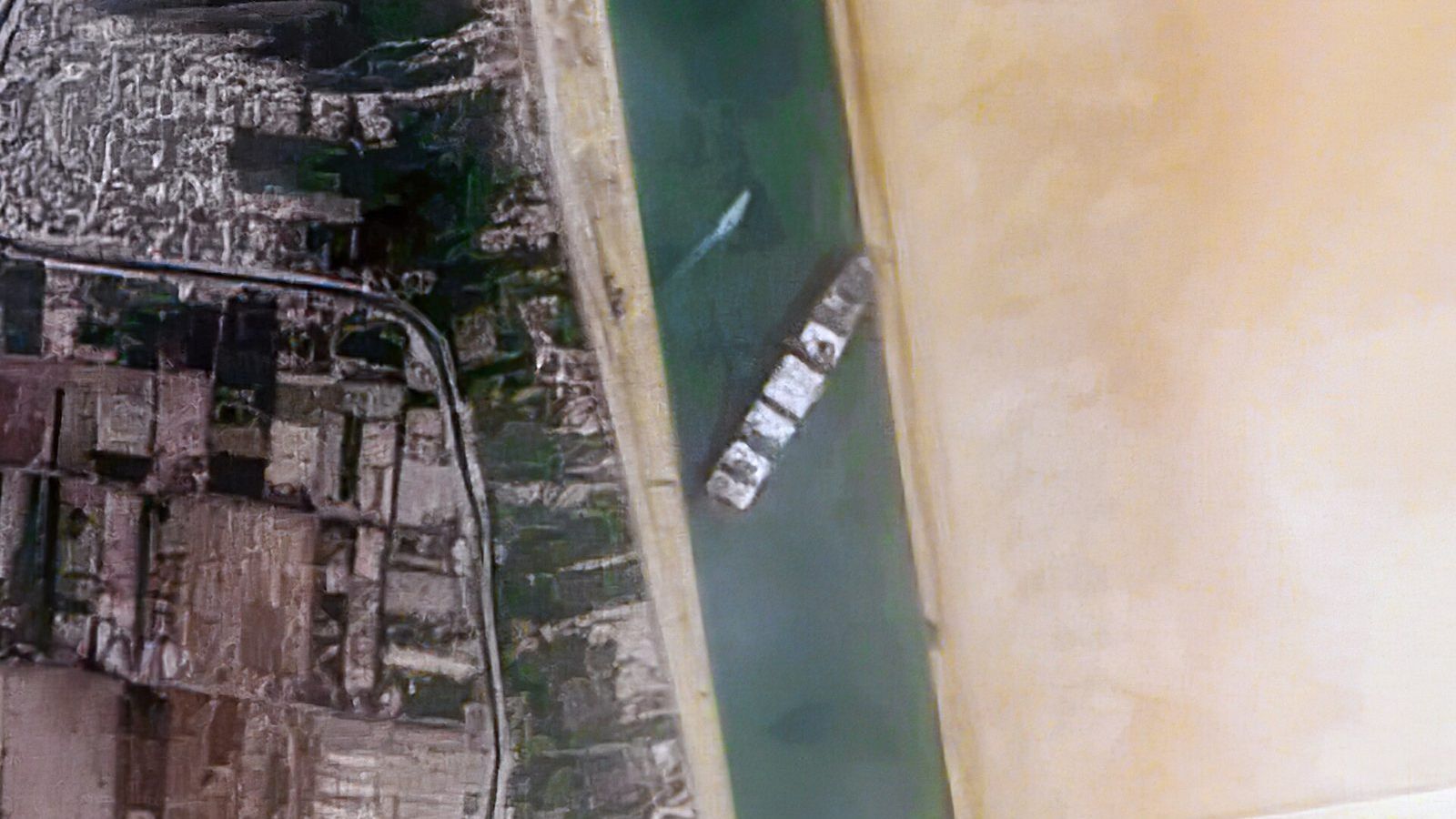
 Image: Contains modified Copernicus Sentinel data [2021], processed by Pierre Markuse (CC BY 2.0)
Six days in the Suez Canal
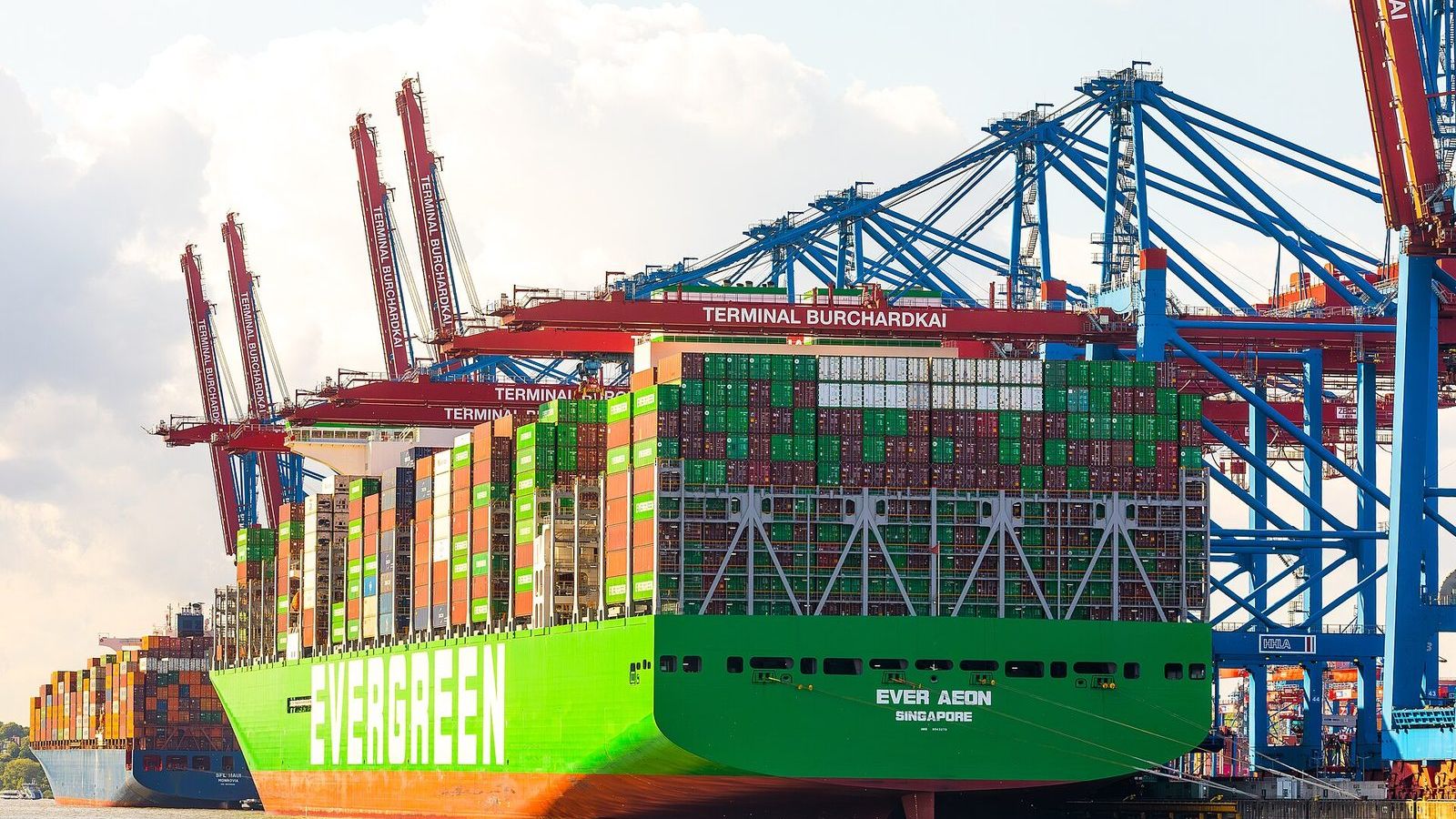
At about 7.40 in the morning of 23 March 2021, in a sandstorm with winds above 40 knots, the container ship Ever Given lost steerage in the southern, single-lane section of the Suez Canal and ran aground with her bow in the eastern bank and her stern against the western one. The ship is 399.94 metres long, which is a little more than the canal is wide at that point, and she was carrying 20,124 twenty-foot equivalent units of containers bound from Malaysia to Rotterdam. For the next six days nothing passed her in either direction.
The Suez Canal Authority brought in dredgers and tugs, removed about 30,000 cubic metres of sand from around the bow, and on 29 March, helped by a spring tide, refloated the ship. By then more than 400 vessels were waiting at either end of the canal or had turned south to go around Africa. Unit 12 of the masterclass uses the week as its case on risk, because for once the cost of a supply chain failure could be counted.
The arithmetic of a blocked canal
About 12 per cent of world trade by volume passes through the canal in a normal year, including roughly 30 per cent of the world's container traffic and a large share of the oil and gas moving from the Gulf to Europe. Lloyd's List, the shipping newspaper, estimated that the goods held up were worth about 9.6 billion US dollars a day, which over six days is close to 60 billion dollars of cargo arriving late. That is not a loss of 60 billion dollars; most of the cargo arrived a week or two late and was sold. The losses were the costs of the delay, and they fell in several places.
The ships waiting at anchor cost their operators tens of thousands of dollars a day each in charter and fuel. The ships that went around the Cape of Good Hope added about 3,500 nautical miles and ten days to the voyage, and burned the fuel to do it. The canal authority lost its transit fees, about 15 million dollars a day. Factories in Europe waiting for parts from Asia lost production, and the just-in-time systems that Unit 4 describes, which hold a few days of inventory because the supply is reliable, found out what happens when it is not. Further down the chain, the containers that arrived late in Rotterdam were not in Shanghai when they were needed for the next voyage, and the shortage of empty boxes in Asia that followed pushed freight rates up through the summer of 2021.
Who paid
The canal authority detained the Ever Given after she was freed and claimed compensation from her owner, the Japanese company Shoei Kisen Kaisha, first of 916 million US dollars, then reduced to 550 million. The ship was released on 7 July 2021 after a settlement whose terms were not published. The owner declared general average, an old rule of maritime law under which every cargo owner on the ship contributes to the cost of saving her in proportion to the value of their goods, so that the companies whose containers were on board paid a share of the salvage. Their insurers paid much of that, and the insurers of the ships that waited, the factories that stopped, and the shops that ran short absorbed the rest, where there was insurance at all. Most of the cost of a delay is never claimed by anyone; it is simply lost.
What the companies did next
The Ever Given was one of a series. The pandemic had already closed ports and emptied factories in 2020; the semiconductor shortage of 2021 stopped car plants for want of chips worth a few dollars each; a fire at a Japanese chip plant in March 2021 and the floods in Germany that summer added more. By 2022 nearly every large manufacturer had a programme to make its supply chain more resilient, and the choices came down to two that Unit 12 sets against each other.
The first is redundancy: hold more inventory, keep a second supplier for every part, or build a second plant in a second region. Redundancy works, and it costs money every day whether or not anything goes wrong. A car maker that holds 30 days of chips instead of 5 has tied up capital that was earning a return, and the arithmetic of Unit 4 says what that costs. The second is flexibility: design products so that parts can be substituted, keep the ability to switch production between plants, and know the supply chain well enough, two or three tiers down, to see a problem coming. Flexibility is cheaper to hold and harder to build, and the firms that weathered 2021 best, by most accounts, were the ones that already knew which of their suppliers' suppliers sat in which city.
The measure that companies have adopted is time to recover: how long it would take to restore full output if a given plant or supplier disappeared. A supply chain with a time to recover of two weeks for its worst case is resilient; one with a time to recover of six months for a part that costs two dollars has a problem that no amount of negotiating with the supplier will fix.
The ship and the canal since
The Ever Given was repaired, returned to service, and still sails. The Suez Canal Authority announced after the grounding that it would widen and deepen the southern section where she stuck, and the work was completed in 2023. In late 2023 attacks on shipping in the Red Sea led most of the large container lines to send their ships around Africa for more than a year, which did to the canal's traffic and to freight rates what the Ever Given had done for six days, over eighteen months. The canal's revenue fell by more than half in 2024. The lesson of the six days, which the industry had been inclined to treat as an accident, turned out to be general: the system is efficient because it runs through a few narrow places, and the narrow places can close.
Unit 12 works the Ever Given as a numerical case, with the length of the ship, the number of containers, the ships that waited, and the estimated value of trade per day from a named source, and then turns to the question that matters to a manager: given that the next blockage will come from somewhere nobody is watching, how much redundancy and how much flexibility should a company buy, and how would it know when it has enough?