 Image: VOC, public domain
The oldest share in the world
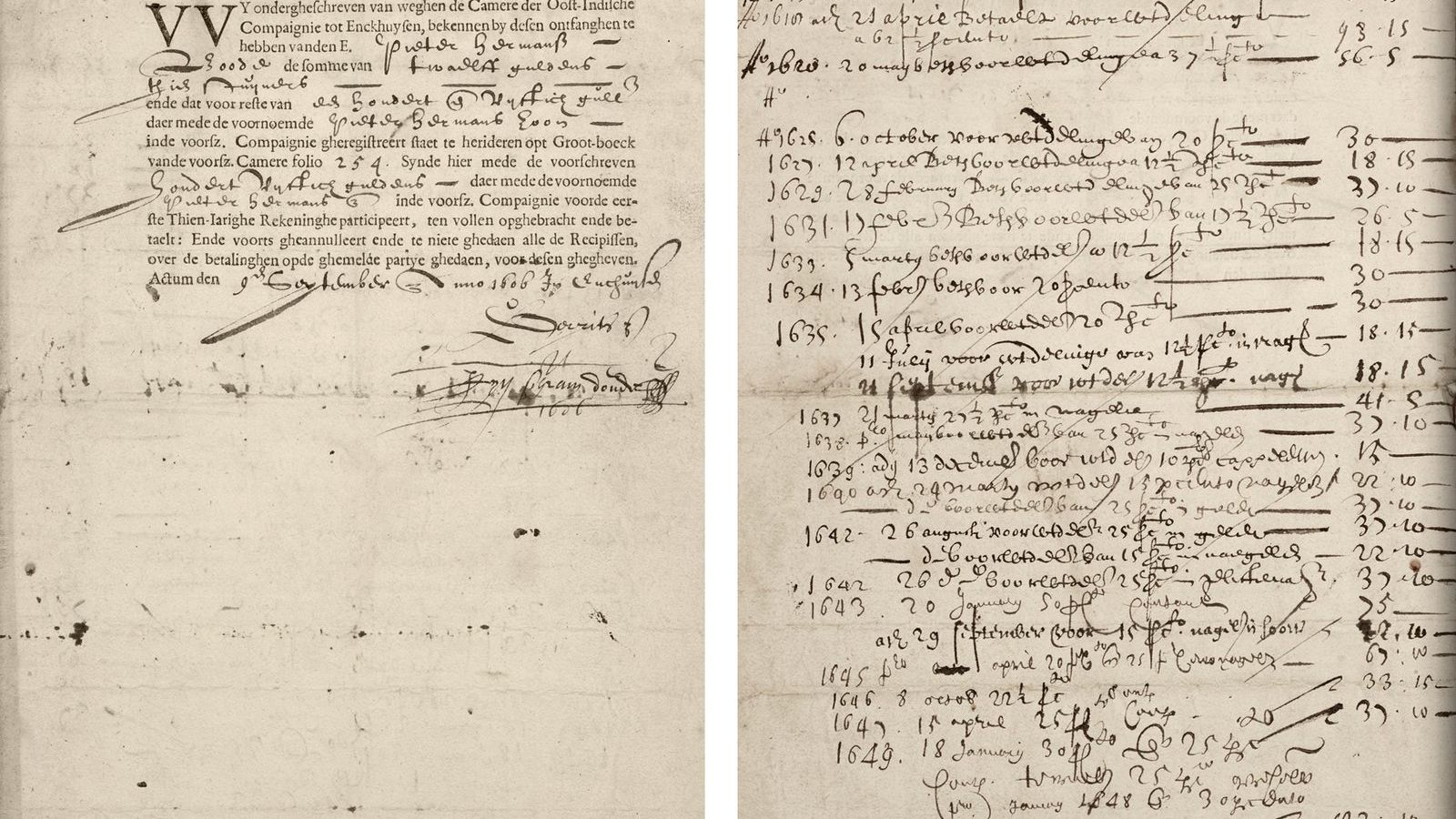
The oldest surviving share in the world is a sheet of paper a little larger than a postcard, written in brown ink in a clerk's hand. It records that on 9 September 1606 a man named Pieter Harmensz Boode paid the last instalment on a stake of 150 guilders in the Enkhuizen chamber of the Verenigde Oostindische Compagnie, the Dutch East India Company, known by its initials as the VOC. The receipt was found in 2010 by Ruben Schalk, a history student at Utrecht University, while he was sorting through papers in the Westfries Archief in Hoorn. For four centuries it had sat in a file of an orphanage that had once received it as part of an inheritance.
Why does a receipt for 150 guilders matter? Because the company that issued it was the first to raise money from thousands of strangers, to make their stakes transferable, and to limit what they could lose to what they had paid in. Those three features are what a share still is in 2026, whether it trades in Amsterdam, New York, or Mumbai.
Six chambers and 6.4 million guilders
The VOC was founded on 20 March 1602, when the States General of the Dutch Republic granted a charter that merged several competing trading ventures into one company with a monopoly on Dutch trade east of the Cape of Good Hope. The charter organized the company into six chambers, one for each of the towns that had run the earlier voyages: Amsterdam, Middelburg, Delft, Rotterdam, Hoorn, and Enkhuizen. Each chamber kept its own books and fitted out its own ships, and together they raised about 6.4 million guilders of capital in the subscription of 1602.
To feel the size of that sum, a skilled craftsman in Holland earned roughly 300 guilders a year at the time, so the capital was about 21,000 years of a craftsman's wages. Amsterdam's chamber alone collected more than half of it, from 1,143 subscribers. Anyone could subscribe, and the register of the Amsterdam chamber lists merchants, widows, servants, and at least one of the company's own clerks among the investors.
The subscribers did not receive a printed certificate. Their stake was an entry in the chamber's capital book, and the receipt that Pieter Harmensz kept was proof that he had paid. Transfers were made by having the buyer and seller appear before the chamber's bookkeeper, who crossed out one name and wrote in another, for a small fee. The entry, and the right to sell it, was the share.
What was new
Partnerships had financed long-distance trade for centuries. In Venice and Genoa, and in the Dutch voyages of the 1590s, a group of merchants put money into one voyage, divided the proceeds when the ships came home, and then wound the venture up. The VOC's charter did something different. It gave the company a life of twenty-one years, with the first accounts to be drawn up after ten, so the capital was locked in for a decade. An investor who wanted their money sooner could not ask the company for it; they had to find someone willing to buy their stake.
That restriction, which annoyed many early investors, is what created a market. From 1602 onwards stakes in the VOC changed hands in Amsterdam, first on the New Bridge and then in the Exchange building opened in 1611, and the price rose and fell with news of ships and spices. Forward contracts, short sales, and options on VOC shares were being traded by the 1610s, and the Republic banned short selling in 1610 after a group of traders was accused of driving the price down. Every argument about speculation that fills the financial pages today was first had about this company.
The second novelty was that an investor's liability ended at the stake. If the company lost a fleet, as it did more than once, the creditors could pursue the company's assets, but they could not come after Pieter Harmensz's house in Enkhuizen. Limited liability is what makes it sensible for a stranger to invest in a venture they cannot supervise, and it is the feature that Unit 1 of the masterclass identifies as the reason the modern company could grow beyond the reach of one family's wealth.
What a share pays
A share has two sources of return, and the VOC illustrated both. The company paid its first distribution in 1610, and it paid it partly in mace, the spice, rather than in cash, which tells you something about what a seventeenth-century balance sheet held. Over the two centuries of its existence the VOC paid dividends averaging around 18 per cent of the nominal capital each year, though the payments were irregular and were sometimes made in bonds rather than money.
The second return is the change in the price of the share itself. A stake of 150 guilders of nominal capital in 1606 would have been worth several times that in the Amsterdam market by the 1620s, and the price of VOC stock peaked at well above 1,000 per cent of nominal in the eighteenth century before the company's decline. The nominal value on the receipt, in other words, soon had nothing to do with what the stake would fetch. Anyone who has looked at the 'par value' printed on a modern share certificate and wondered why it is one cent has met the same distinction.
Here is the arithmetic that a 1606 investor could do and that a 2026 investor still does. Suppose a share pays a dividend of 18 guilders a year on 150 guilders of nominal capital, and the share trades at 300 guilders. The dividend yield to a buyer at that price is 18 divided by 300, which is 6 per cent a year. Whether that is attractive depends on what else the 300 guilders could earn, and in 1606 a loan to the city of Amsterdam paid around 6 per cent as well, with far less risk of a fleet sinking. The rate at which money could be lent safely is the yardstick against which every riskier investment is measured, and Unit 6 builds the whole theory of discounting on that comparison.
Why the receipt survived
The stake passed in time to the Enkhuizen orphanage, which held it as an endowment, collected the dividends, and noted each payment on the back of the sheet until 1650. The orphanage's papers ended up in the regional archive in Hoorn, where the receipt sat unexamined among thousands of other documents. Schalk recognized the date and the chamber, and the archive confirmed it as the oldest known share. An older instrument may yet turn up: the Amsterdam chamber issued receipts in 1602, four years earlier, but none has been found.
The receipt is on display in Hoorn, and it does something that no modern share can. It shows the whole idea on one page. A named person pays a stated sum into a company with a fixed life, receives a claim on its profits in proportion to what he paid, can sell that claim to anyone the bookkeeper will register, and risks nothing beyond the sum. Four hundred and twenty years later, the claim is an entry in an electronic register, the bookkeeper is a central securities depository, and the fleet may be a software company, but the five elements are the same.
In the masterclass, the Enkhuizen share appears in Unit 1 as the opening of the section on what a firm is, and again in Unit 5, where the equity line on a balance sheet turns out to be a direct descendant of the chamber's capital book. The full list of units is in the curriculum.