 Image: Unknown author, public domain
93 minutes
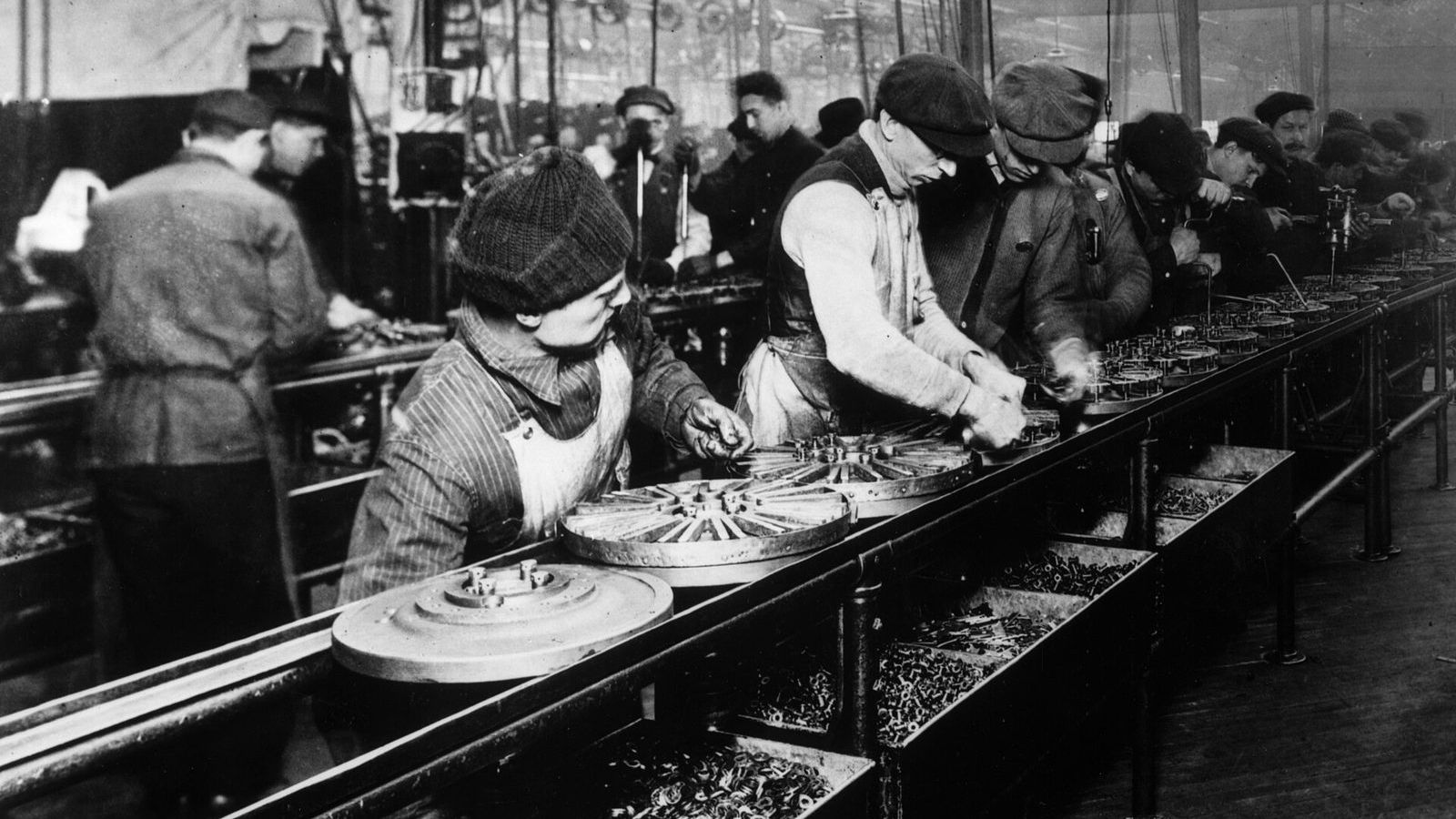
On 7 October 1913, in the Highland Park plant north of Detroit, Ford's engineers attached a rope to a Model T chassis and pulled it slowly past a line of workers, each of whom fitted one part as it went by. Before that day a chassis was built by a team of men who walked around it, fetching parts, and the job took about 12.5 hours of labour. By the spring of 1914, with the rope replaced by a chain and the line raised to waist height, the figure was 93 minutes. Ford's own history of the plant gives those two numbers, and they are among the few in business history that deserve the word revolution.
What changed on the floor
The parts of the idea were old. Meat packers in Chicago had been moving carcasses past stationary butchers on overhead rails since the 1860s, and Ford's engineers said later that they had seen it. Interchangeable parts, machined to tolerances that allowed any part to fit any car, had been the aim of American armouries for a century and were in place at Ford by 1908. What Highland Park added was the decision to move the work to the worker, for every stage of the car, at a pace the company set.
The chassis line was the last of a series. Ford had tried a moving line for the flywheel magneto in April 1913 and cut the assembly time from 20 minutes to 13, then to 5 after the line was raised and the pace adjusted. Engines and transmissions followed. The chassis line made the whole plant a single flow: parts arrived at the point where they were fitted, in the order they were needed, and a worker who had once walked for parts stood still and did one task roughly every minute and a half.
The change in the time per chassis was the sum of three effects. The walking stopped. Each task was simplified until it could be learned in a day, so a new worker reached full speed in hours instead of months. And the chain set the pace, so no worker could slow the line. Unit 4 of the masterclass calls this the bottleneck principle: the output of a process is set by its slowest step, and a moving line makes every step the same speed by design.
Five dollars a day
The line had a cost that did not appear in the engineering reports. The work was monotonous, and the men left. In 1913 Ford's turnover of labour was about 370 per cent, meaning the company hired nearly four workers over the year for every job in the plant, and each new hire had to be trained. Absenteeism ran at 10 per cent on an ordinary day.
On 5 January 1914 the company announced that it would pay a minimum of five dollars for an eight-hour day to qualifying workers, roughly double the going rate for unskilled factory work in Detroit, and would cut the working day from nine hours to eight. The announcement made the front pages, and the next morning thousands of men stood outside the gates in the snow. Turnover fell to a fraction of its former level within a year. Whether the Five Dollar Day paid for itself in lower hiring and training costs, as Ford claimed, or was also a way of buying peace with a workforce that might otherwise have organized, has been argued over by historians for a century. Both can be true.
The price
The Model T had been introduced in October 1908, and in 1909 the runabout listed at 825 dollars. By 1925 the same model listed at 260 dollars, and the touring car, which had been 850, was below 300. Over the same years the general price level in the United States roughly doubled, so the real price fell by about 80 per cent. Ford sold about 15 million Model Ts in all, and in the early 1920s the car accounted for roughly half of the automobiles made in the world.
The price fall was the point. Henry Ford's stated policy was to cut the price, find out what the new price did to sales, and then find the cost reductions needed to make a profit at that price, rather than to compute a cost and add a margin. The moving line was what made the policy possible. The contribution per car fell with every price cut, but the volume rose faster, and the fixed costs of the plant were spread over more and more cars. Unit 1 of the masterclass works this through as a break-even problem: a plant with high fixed costs and a falling variable cost per car can cut its price and raise its profit at the same time, provided the customers arrive.
Here is the arithmetic in outline. If the chassis time fell from 12.5 hours to 1.55 hours and the wage rose from about 2.5 dollars to 5 dollars a day, the labour cost of a chassis fell from about 3.9 dollars to about 1 dollar even after the doubling of the wage. Similar reductions through the rest of the car explain how the company could cut 565 dollars from the price of a runabout in sixteen years and still earn, in 1923, a profit of more than 80 million dollars.
What the line did not solve
The line built one car. Highland Park was designed to make the Model T and nothing else, in one colour from 1914, and the dies, jigs, and the sequence of the line were all specific to it. When buyers began to want something different in the mid-1920s, and General Motors offered a car for every purse and purpose, Ford had no way to respond without stopping the plant. Production of the Model T ended on 26 May 1927, and the company closed its plants for six months to retool for the Model A. Unit 8 tells that story as the first great case of a leader overtaken by a competitor who understood the customer better.
The line also set the terms of the next sixty years of argument about factory work. The job that could be learned in a day could be done by anyone and offered nothing to learn after the first week. The Hawthorne studies of the 1920s, the human relations movement, and the Toyota Production System, which gave the worker on the line the right to stop it, were all answers to a question that Highland Park posed. Unit 4 presents the moving line and Toyota's system as the two great ideas of operations, half a century apart, and the Toyota half is the subject of the next article on this blog.
Ninety-three minutes remains the number to remember. It is the measure of what reorganizing the work, without any new technology in the parts themselves, can do to the cost of a product, and it is why operations is a subject rather than a set of tips.