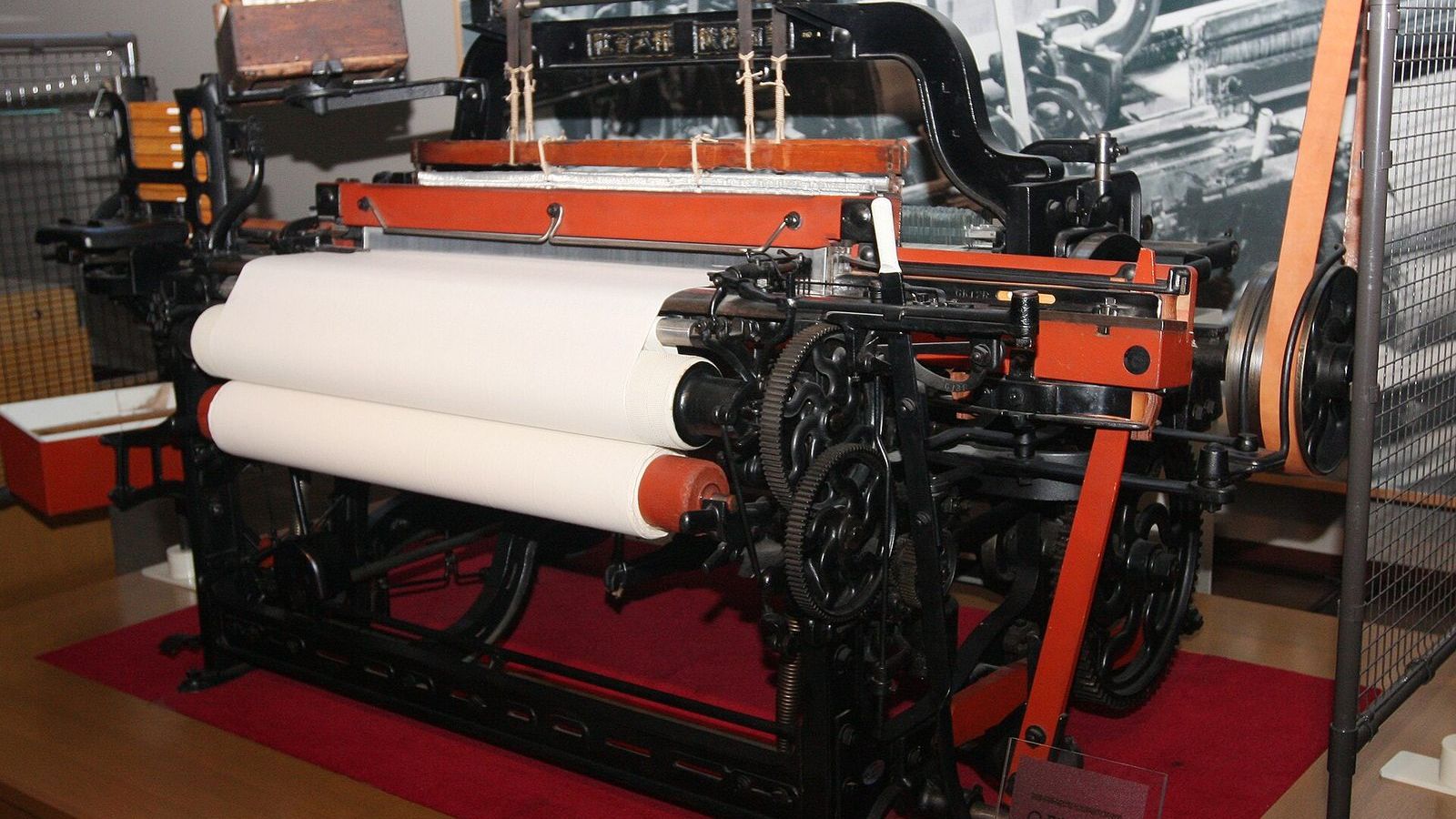
 Image: Morio (CC BY-SA 3.0)
Why Toyota lets any worker stop the line
Above every workstation on a Toyota assembly line hangs a cord. A worker who sees something wrong, a bolt that will not seat, a scratch, a part that is not the part the sheet says, pulls it. A tune plays, a board lights up with the station number, and a team leader arrives. If the problem is not fixed before the car reaches the end of the station, the line stops. Any of the several thousand people in the plant can do this, and they do it many times a shift.
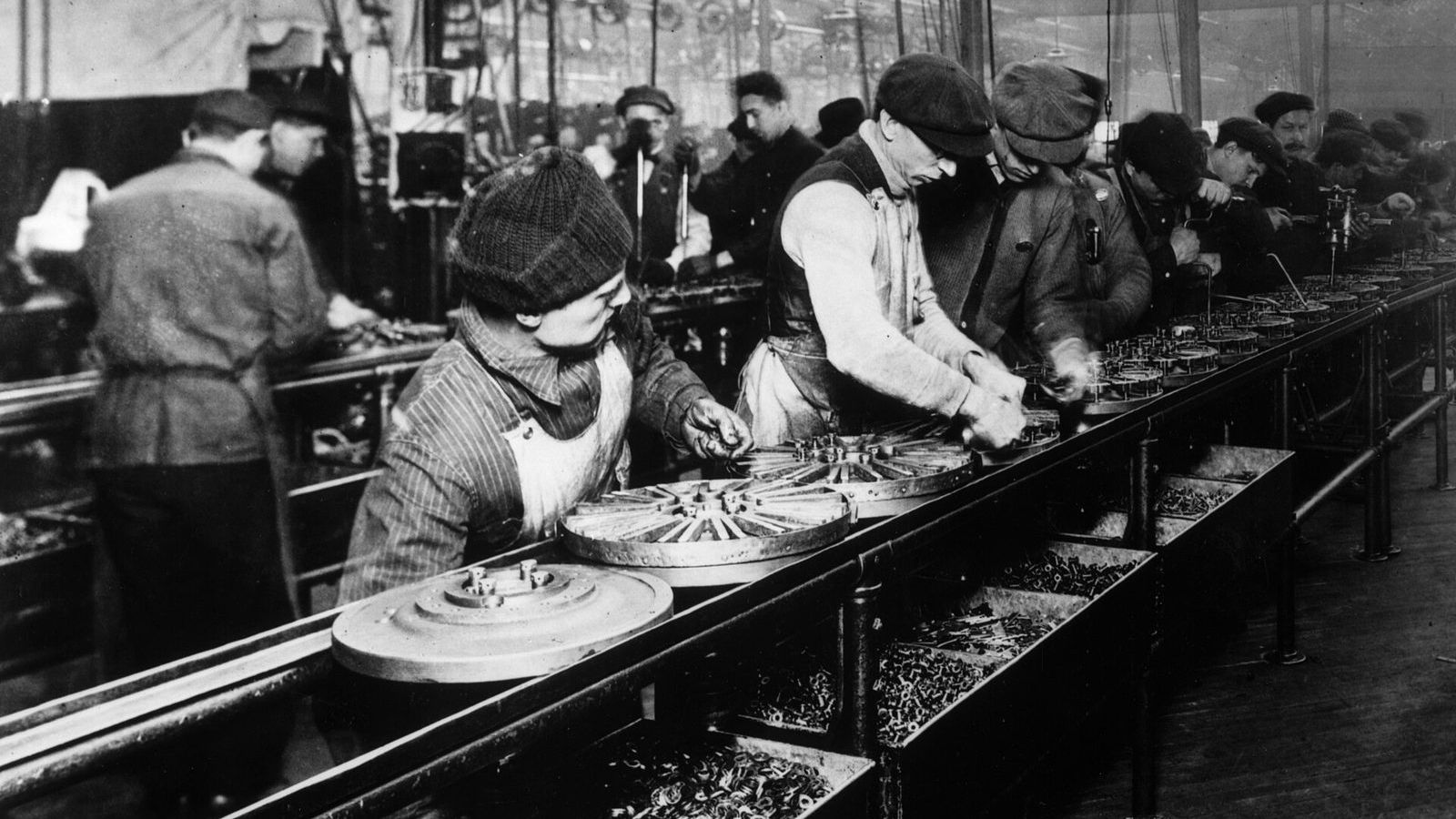
To a visitor from a plant run on the Highland Park model of 1913, the cord looks like an invitation to chaos. A stopped line produces nothing, and every minute costs the output of a car worth tens of thousands of dollars. Toyota's answer rests on a comparison of two costs and on a loom that was built before the company made cars.
The loom that stopped itself
Sakichi Toyoda, born in 1867 to a carpenter in Shizuoka prefecture, spent his life improving looms. His Type G automatic loom of 1924 could change its shuttle without stopping, and it had a device that stopped the loom the instant a warp thread broke. The point of that device was economic. A loom that kept running after a break wove a flaw into the cloth, and the flaw was found later, when the bolt was inspected, by which time many metres of cloth were spoilt. A loom that stopped itself wove no flaw. Equally important, one worker could now watch many looms, because the looms raised the alarm themselves rather than needing a pair of eyes on each.
The loom was good enough that Platt Brothers of Oldham, then the world's leading maker of textile machinery, bought the rights to it in 1929. Toyota's own history records an agreed price of 100,000 pounds, later reduced to 83,500 after the depression hit the cotton trade. Sakichi's son Kiichiro used part of that money to start research on cars, and the automobile department of Toyoda Automatic Loom Works became Toyota Motor in 1937.
The idea travelled with the family. Toyota calls it jidoka, which the company's own description of its production system translates as automation with a human touch: a machine or a person stops immediately when an abnormality is detected, so that no defective product goes on to the next step. Jidoka is one of the two pillars of the Toyota Production System. The other is just-in-time, the idea of making only what is needed, when it is needed, in the amount needed.
Two costs, compared
The argument for the cord is an argument about where a defect is cheapest to fix. A loose bolt found at the station where it was fitted costs a minute. The same bolt found at the end of the line, after the trim and the interior have been fitted over it, costs an hour of rework in a repair bay. Found by the dealer, it costs a warranty claim and a dissatisfied customer. Found on the road, it costs a recall. Each step down the line multiplies the cost of the same defect, and the multiplier is large.
Now weigh that against the cost of stopping. A line producing one car a minute that stops for one minute loses one car's worth of output, but only if the stop is never made up, and in practice most pulls of the cord do not stop the line at all, because the team leader resolves the problem within the station's cycle. The pulls that do stop the line are the ones where a real problem has been found, and the stop is the cheapest moment to fix it. The comparison comes out in favour of the cord as long as the plant takes the second step, which is to find out why the problem occurred and change the process so that it does not recur. Without that step the cord is just a very expensive way of catching defects. With it, the number of pulls falls over time, and the line runs faster than a line that never stops but ships defects.
What the figures showed
The comparison between Toyota and its American rivals was made in numbers in the 1980s, when the MIT study of the world's car plants found that the plants in Japan used about two-thirds of the hours per car of the American ones, 17 hours against 25, and delivered cars with about a quarter fewer defects in the first months of ownership. The numbers surprised the industry because it had assumed a trade-off: quality cost money, speed cost quality. Toyota's plants had both, and the cord was one of the reasons.
The other pillar produced a number of its own. A plant that makes only what the next step needs holds very little inventory, and inventory is money sitting still. In the research spotlight of Unit 4 of the masterclass, Gérard Cachon and Marcelo Olivares measured the inventory of finished cars at dealers across the US industry in the 2000s and found that Toyota held far less than Chrysler, Ford, and General Motors, and that nearly all of the gap was explained by two things: the number of dealers in the network and the flexibility of production. A plant that can switch between models without a long changeover does not need a stock of each model waiting for a buyer.
Why it was hard to copy
Every car maker in the world has visited a Toyota plant, and the cord is not a secret. Yet the gap in hours and defects took the American and European industry two decades to close, and in some measures it has not closed. The reason is that the cord is a small visible piece of a system that is mostly invisible: team leaders who arrive within seconds, a culture in which pulling the cord is expected rather than punished, suppliers who deliver to the hour, and a habit of asking why five times before fixing anything. Copying the cord without the rest produces a line that stops and stays stopped.
That is the lesson that Unit 2 draws about competitive advantage in general. A practice that can be seen and copied in a week gives no lasting advantage, because every rival copies it. A practice embedded in thousands of daily habits can be seen just as clearly and still takes twenty years to reproduce, and in those twenty years the firm that has it earns the difference.
Unit 4 of the masterclass presents the Toyota Production System as the second great idea of operations, after the moving line of 1913, with the seven wastes, the kanban card, and the control chart, and it uses the Toyoda loom as its opening excursion. The loom itself survives in Toyota's museum in Nagoya, and it still stops when a thread breaks.