 Image: Photograph by Greg O'Beirne (CC BY-SA 3.0)
Little's law at the airport
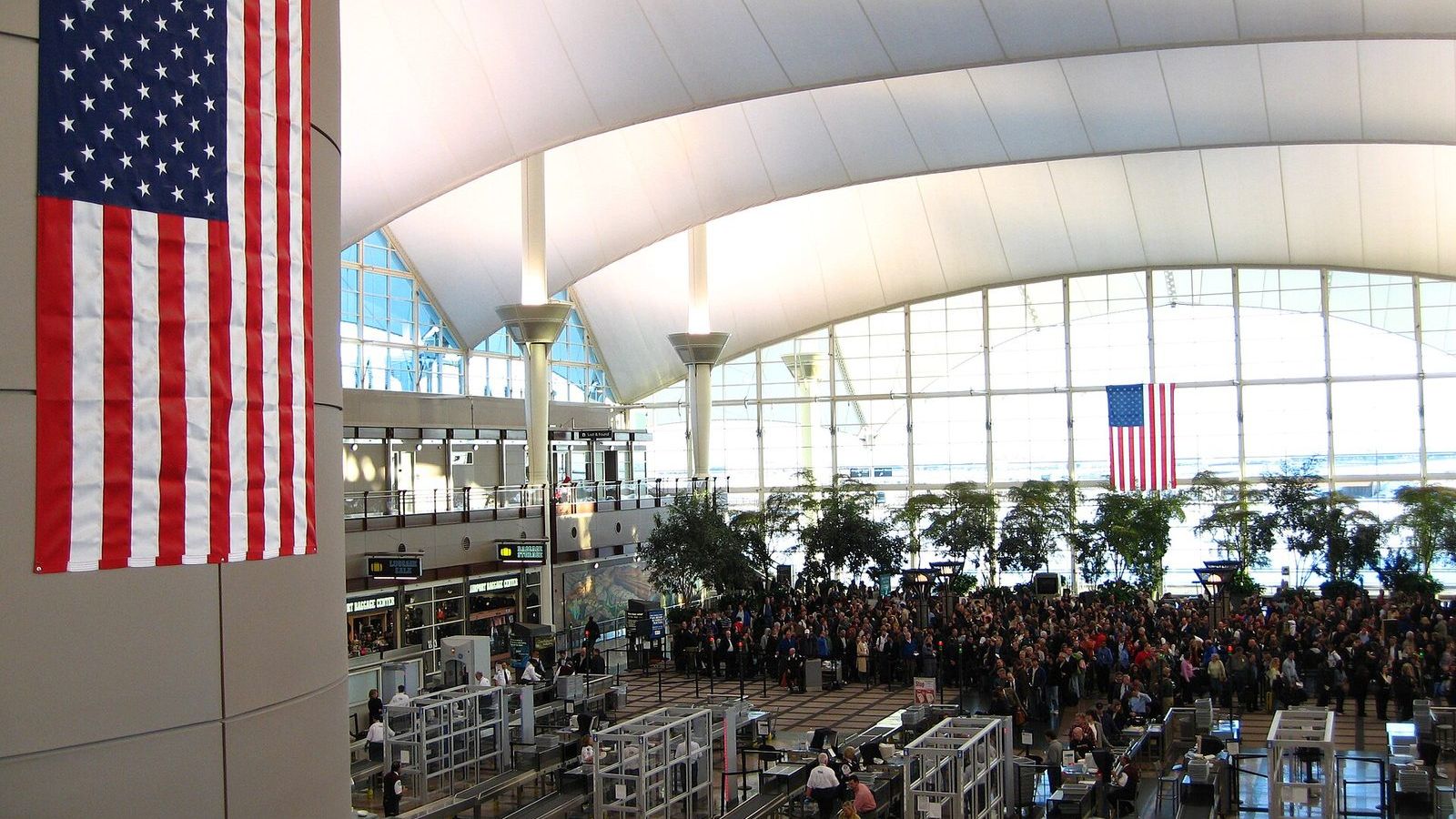
Stand at the back of the security queue at an airport and count. There are about 200 people ahead of you, and at the front the scanners are passing about 10 passengers a minute. Your wait will be about 20 minutes. You have just used Little's law, and you have used it without knowing anything about when the people ahead of you arrived, how many lanes are open, or whether the family at the front has remembered to take the laptops out.
The relation
The law was proved by John D. C. Little, a professor at MIT, in a paper published in 1961 in the journal Operations Research. In the notation of queueing it reads \(L = \lambda W\): the average number of customers in a system equals the average rate at which they arrive multiplied by the average time each one spends there. Unit 4 of the masterclass writes it in the words of operations:
\[ I = R \cdot T, \]where \(I\) is the inventory, the number of items in the process; \(R\) is the throughput, the rate at which items pass through; and \(T\) is the flow time, how long each item spends inside. Know any two and you have the third. At the airport, \(I\) is 200 people, \(R\) is 10 a minute, and \(T\) is 200 divided by 10, which is 20 minutes.
What made Little's result worth a paper is what it does not require. The arrivals can be regular or random, the service times can vary, there can be one lane or twelve, and the queue can be a line of people or a pile of files. The law holds for any stable system observed over a long enough time, where stable means that items are not piling up without limit. It is a statement about averages, not about your particular wait, which may be longer if you are behind the family with the laptops.
Three queues that do not look like queues
A bank has 1,200 mortgage applications in progress and approves or rejects 60 a day. The average application therefore takes 20 working days, four weeks, whatever the bank's brochure promises. If the bank wants to cut the time to two weeks without turning anyone away, the law gives it two options and no third: approve 120 a day, or keep the number of applications in progress at 600 by starting fewer. It cannot simply ask its staff to work faster on each file, because each file already waits 19 of its 20 days in someone's in-tray, and the work on it takes a day.
A hospital has 300 beds, all occupied, and discharges 50 patients a day. The average stay is 6 days. A new ward of 60 beds will let the hospital treat 60 more patients at a time, or, at the same number of beds, every day cut from the average stay admits 50 more patients a week. The hospital's management, which argues about beds, is often arguing about flow time without knowing it.
A car plant holds 4 billion dollars of inventory, counting raw materials, parts, and cars not yet sold, and its cost of sales is 80 billion a year. Its inventory is therefore 4 divided by 80 of a year, which is 18 days: on average a dollar enters the plant as a part and leaves as a sold car 18 days later. Unit 5 calls this figure inventory days and computes it from the balance sheet, and it is Little's law applied to money rather than to people.
Why the queue gets long before the lanes are full
The law relates three averages. It does not say what any of them will be, and in particular it does not say how long the queue will get when the scanners are nearly busy all the time. For that a model of randomness is needed, and the simplest one, with random arrivals and random service times, gives a result that every operations manager learns to fear. If the scanners are busy 80 per cent of the time, the average number waiting is about four times the number being served. At 90 per cent it is nine times. At 95 per cent it is nineteen times. The waiting time roughly doubles between 80 and 90 per cent utilization and doubles again by 95.
The reason is that a busy system has no slack to absorb a cluster of arrivals. When three flights' worth of passengers arrive together, a lane that is idle 20 per cent of the time catches up within minutes; a lane that is idle 5 per cent of the time takes an hour, and by then the next cluster has arrived. Airports that run their security at 95 per cent utilization to save on staff pay for it in queues, and the airport's figures will show a modest average wait that hides a very bad hour every morning.
Little's law and the utilization curve together explain a pattern that managers see everywhere and usually blame on the staff. A process that is run close to its capacity has long flow times, large inventories of work in progress, and unhappy customers, and adding a small amount of capacity, from 95 to 85 per cent utilization, shortens the queue far more than the arithmetic of capacity alone suggests. Unit 4 plots the curve and asks you to find where your own examples sit on it.
Where the law breaks
The law needs a stable system and a long enough window. Measure the airport at 6 am, when the queue is building and nobody has yet passed the scanners, and the three numbers will not fit, because the system is not in a steady state. Measure a shop on the day before a holiday and the inventory sold that day bears no relation to the inventory that was ordered for it. The law is a statement about averages over an interval in which what comes in roughly equals what goes out, and if that condition fails, so does the arithmetic.
It also says nothing about who waits. The average passenger waits 20 minutes; the passenger in the fast-track lane waits 2 and the passenger behind the family waits 40. A company that quotes the average to its customers will be told it is lying by half of them. The distribution matters, and the law is silent on it.
The third limit is the definition of the system. The 200 people in the queue are the inventory of the security process, but the airport as a whole holds people from the car park to the gate, and the flow time of that larger system, with its own \(I\) and \(R\), is the one the passenger experiences. Choosing the boundary is the first step of any process analysis, and choosing it badly produces a correct answer to the wrong question.
A rule for the pocket
Here is the version to carry around. Count what is waiting, measure what is coming out per hour, and divide. The result is the time a new arrival will spend inside, on average, and it is right regardless of the details. If someone proposes to shorten the time, ask which of the other two numbers they intend to change. If they cannot say, they intend to change neither, and the time will not move.
Unit 4 of the masterclass uses Little's law as its one equation, applies it to an emergency department, a loan process, and a car plant, and connects it to the inventory line on the balance sheet. The interactive element of the unit lets you set the arrival rate and the capacity of a three-step process and watch where the queue forms.